SPECIES DESCRIPTION
VIOLA FRAGRANS
Family and Genus:- See- VIOLACEAE/Sect. MELANIUM
Common Names:- None
Homotypic Synonyms:- None
Meaning:- Viola The Latin name applied to several fragrant plants.
Fragrans (L) Sweet scented, odorous, fragrant.
General description:- Glabrous or slightly short-pubescent perennial, somewhat
woody at base,
Stems:-
1) 5-10(-15) cm. numerous and dense. several slender, ascending and flowering.
Leaves:-
1) 1,5 cm, narrowly elliptical to broadly oblanceolate, obtuse, gradually narrowed to
the petiole, entire.
2) Stipules, resembling the leaves but smaller.
Flowers:-
1) Usually, c. 1 cm, but rather variable in size, 1-2 per stem,:
a) spur c. 3 mm, stout, 2-3 times as long as calycine appendages.
2) Peduncle, long and slender, much exceeding the leaves.
3) Sepals c. 6 x 2 mm, lanceolate, with short, truncate appendages.
4) Corolla, longer than wide in face view, very variable in colour, from almost white
to bright yellow, often with violet shade or streaks on lower petal and spur.
a) lateral petals, bearded at the base.
b) lower petal, including the spur 12-16 mm;
c) spur, stout, obtuse, much exceeding the calyx appendages.
Fruit:-
1) Capsule, erect at maturity, glabrous.
2) Seeds, with an oily appendage.
Key features:-
1) Spur, 2-3 times as long as calycine appendages.
2) Leaves, c. 1·5 cm, gradually narrowed to petiole.
Habitat:- Rocky slopes, screes and dolines, often protected by spiny shrublets in
thorncushion communities. (1300-)1700-2350 m.
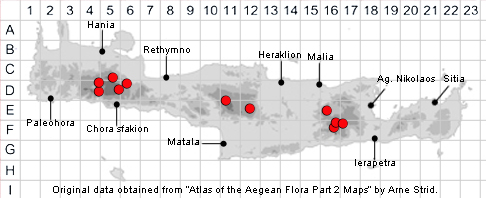
Distribution:- Endemic to the three main massifs.
Flowering time:- May-July(-Aug).
Photos by:- Yannis Zacharakis
Status:-
Protection status (for threatened species): Greek Presidential Decree 67/1981.