SPECIES DESCRIPTION
TEUCRIUM ALPESTRE
Including:- Teucrium gracile.
Family and Genus:- See- LABIATAE/Sect. POLIUM
Common Names:- None
Homotypic Synonyms:- None
Meaning:- Teucrium (Gr) A name used by the Greek physician and botanist
Dioscorides, perhaps for the hero and first King of Troy, Teucer.
Alpestre (L) Of mountains, of the lower Alps.
General description:- Dwarf, densely branched, hairy shrub.
Stems:-
1) Up to 20 cm, with patent hairs.
Leaves:-
1) 4-10 mm, obovate to linear, with 3-5 crenations, flat or with revolute margins,
cuneate at the base, subsessile.
Flowers:-
1) In a terminal head, with occasional solitary, axillary flowers.
2) Calyx, campanulate, evenly hairy with dense short hairs, veins obscure.
3) Corolla, 6-8 mm, cream, with oblong-spathulate lateral lobes.
Fruit:-
1) Nutlets, smooth or reticulate.
Key features:-
1) Calyx, principal veins obscured by the indumentum.
2) Flowers, in a loose terminal head at least as wide as long.
Habitat:- In a wide variety of habitats from coastal flats to dolines and alpine
thorncushion communities. 0-1400(-2000) m.
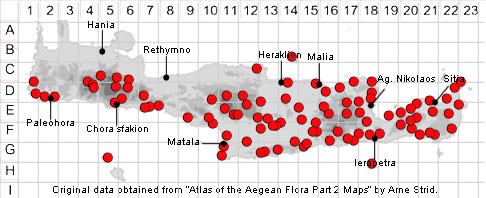
Distribution:- Cretan endemic. Widespread and common.
Flowering time:- Apr-July.
Photos by:- Steve Lenton
~~~~~~~~~~~~~~~~~~~~~~~~~~~~~~~~~~~~~~~~~~~~~~~~~~~~
TEUCRIUM GRACILE Back to Top
Homotypic Synonyms:-
Meaning:-
Resembling Teucrium alpestre, but differering in the following characters
1) Somewhat taller, caespitose, often untidy-looking with many dead twigs;
2) Leaves, oblanceolate.
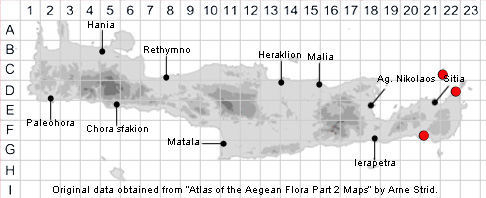
It seems doubtful whether T. alpestre and T gracile can be retained at species.
1) Atlas of the Aegean Flora. Book one, Arne Strid. 2016.
Habitat:- As for T. alpestre
Distribution:- As for T. alpestre
Flowering time:- As for T. alpestre
Photos by:-