STERNBERGIA LUTEA subsp. LUTEA
Including: Sternbergia fischeriana
Family and Genus:- See- AMARYLLIDACEAE
Common Names:- Common sternbergia
Homotypic Synonyms:- Sternbergia lutea
Meaning:- Sternbergia (L) For Count Kasper Moritz von Sternbergia of Prague.
(1761-1838).
Lutea.(L) Yellow, vile, of clay, muddy.
General description:- Herbaceous plant.
Scape:-
1) Erect, non-leafy, glabrous, well developed, at least 4 cm at anthesis, later
elongating and usually curved.
Bulb:-
1) 10-16mm diam.
Leaves:-
1) 3-10(-15) mm wide, developing at or just after anthesis, linear, slightly
canaliculate on the upper surface, bright glossy green without a central stripe.
Flowers:-
1) Perianth segments, bright yellow, usually oblong-elliptical, goblet-shaped and
crocus-like.
2) Tepals, 3.5-6 x 1-2.3 cm, rounded at the apex.
Fruit:-
1) Capsule, 8-10 mm diam, 3 chambered, fleshy.
Habitat:- Dry stony and grassy places, open scrub.
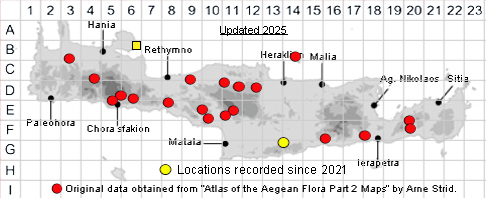
Distribution:- Endemic Crete & Karpathos. Occurring very sporadically in the
central and western parts of the island.
Flowering time:- Oct-Dec.
Photos by:- Fotis Samaritakis
SPECIES DESCRIPTION
~~~~~~~~~~~~~~~~~~~~~~~~~~~~~~~~~~~~~~~~~~~~~~~~~~~~
STERNBERGIA FISCHERIANA Back to Top
Homotypic Synonyms:- Sternbergia vernalis.
Meaning:- Fischeriana (L) For Friedrich Ernest Ludwig von Fischer (1782-1854)
Director of the Botanical Garden at St Petersburg.
Resembling Sternbergia lutea, but differering in the following characters:
Flowers large, similar in size to those of S. lutea, but with distinctive, flat leaves
with a rounded tip.
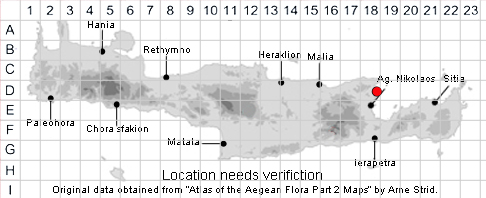
A recent record of this spring-flowering plant, (January-February), from eastern
Crete.The species has an unusual, scattered distribution in western and central
Asia and it seems likely that it has been introduced into many of the recorded
localities, including this one in Crete. 1).
1) Extract from "Flowers of Crete" Fielding & Turland 2005:
Habitat:- Dry stony and grassy places, open scrub.
Distribution:- Western and central Asia
Flowering time:- Jan-Feb
Photos:- Unavailable