SPECIES DESCRIPTION
SALVIA VIRIDIS
Family and Genus:- See- LABIATAE/Sect. HORMINUM
Common Names:- Red-topped sage
Homotypic Synonyms:- Horminum viride, Ormilis viridis, Salvia horminum
var. viridis, Sclarea viridis.
Meaning:- Salvia (L) Healer, the old Latin name for sage with medicinal
properties.
Viridis (L) Youthful, fresh-green.
General description:- Short to medium, hairy annual.
Stems:-
1) Up to 50 cm, erect, simple or branched, eglandular- or glandular-hairy, topped
by a coma of sterile bracts.
Leaves:-
1) Basal and cauline, with the petiole almost as long as the blade; the latter simple,
ovate-elliptical, crenulate, pubescent or strigulose, green on both sides.
Flowers:-
1) Verticillasters, 4-6-flowered, usually distant below and approximated above.
2) Pedicels, c. 5 mm, compressed, deflexed in fruit.
3) Calyx, 7-10(-12) mm, tubular, with short teeth.
4) Corolla, 14-18 mm, usually pale lilac;
a) upper lip, almost straight.
Fruit:-
1) Achenes, 4, 3-angled and smooth.
Key features:-
1) Corolla, 14-18 mm, the upper lip ± straight.
2) Leaves, pubescent or strigulose.
3) Pedicels, compressed, deflexed in fruit.
Habitat:- Sandy and rocky coastal habitats, field margins, open dry shrubby
vegetation, dry meadows, deciduous oak scrub. 0-1100 m.
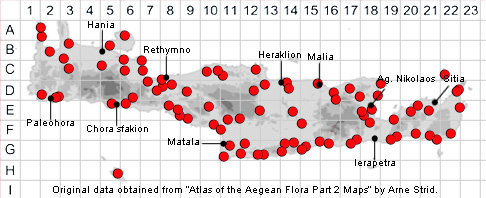
Distribution:- Widespread throughout the Mediterranean region and SW Asia.
Widespread and common on Crete.
Flowering time:- Mar to early June.
Photos by:- Steve Lenton