SPECIES DESCRIPTION
RUMEX BUCEPHALOPHORUS subsp. BUCEPHALOPHORUS
Family and Genus:- See- POLYGONACEAE/Subgen. PLATYPODIUM
Common Names:- Horned or red dock.
Homotypic Synonyms:- Bucephalophora aculeata, Bucephalophora aculeata
subsp. hispanica, Rumex bucephalophorus ssp. graecus.
Meaning:- Rumex (L) A name used by the Roman naturalist and philosopher Pliny
for sorrel.
Bucephalophorus (L) Ox-head bearing.
General description:- Very variable low to medium annual
Stems:-
1) 5-15(-20) cm. one to several, ascending to erect, simple or sparsely branched.
Leaves:-
1) Alternate, petiolate, simple, entire, from 10-20 mm long, blade with cuneate base
a) lower, spatulate, not more than 3½ times as long as wide.
b) upper, lanceolate hairy.
Flowers:-
1) Inflorescence, a simple or branched raceme with flowers in clusters of 2 or 3,
often occupying most of plant.
2) Flowers and pedicels, usually dimorphic, filiform or becoming flattened and
dilated after anthesis, recurved in fruit and often tinged crimson or purple.
3) Pedicels, heteromorphic, some cylindrical and short, others long, curved, convex
and clavately thickened.
Fruit:-
1) Nutlet, sharply triquetrous, brown.
2) Fruiting valves, triangular with 2-3(-4) broad teeth at the base on each side.
Key features:-
1) Teeth of the valves, straight or slightly curved.
2) Lower leaves, not more than 3½ times as long as wide.
3) Flowers in clusters of 2-4.
4) All valves broadly triangular, with 2(3) stout teeth on each margin.
Habitat:- Coastal sand, rocky and stony places, open ground in dry open shrubby
vegetation, sometimes in fallow fields, road embankments and ruderal habitats. 0-
800(-1400) m.
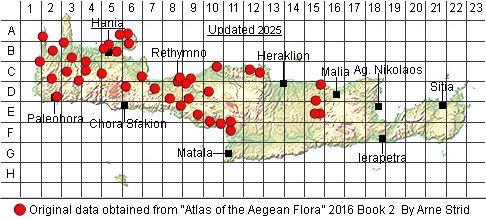
Distribution:- Mediterranean region, E. to W. Turkey, including Portugal but not
Cyprus. Widespread and common on Crete, but more so in the west.
Flowering time:- Late Mar-June.
Photos by:- Steve Lenton