SPECIES DESCRIPTION
ROSA CANINA
Family and Genus:- See- ROSACEAE/Sect. CANINAE/R. CANINA Group
Common Names:- Dog rose
Homotypic Synonyms:- Rosa corymbifera, Rosa dumetorum, Rosa nitidula.
Meaning:- Rosa (L) Latin name for various roses.
Canina (L) Of the dog, sharpe-toothed or spined.
General description:- Erect shrub usually 1-3 m tall.
Prickles:-
1) Uniform, rather stout, ± curved, compressed with a dilated base.
Stems:-
1) Reaching up to 3 m. flowering, rarely unarmed.
Leaves:-
1) Consisting of up of 5-7 leaflets, 15-40 x 12-20 mm, ovate, obovate or elliptical,
serrate or compound-serrate, glabrous and eglandular, glaucous, dark green,
shining or dull above
2) Petiole and rhachis, often with acicles.
Flowers:-
1) Usually in small clusters.
2) Pedicels, 10-20 mm, as long as or longer than the fruit, glabrous.
3) Sepals, lobed, eglandular or sparsely glandular-ciliate, deflexed after anthesis,
usually deciduous before fruit ripens.
4) Petals, 15-25(-30) mm, pink to white.
5) Hypanthium, variable in shape, smooth or rarely glandular-stipitate, red when
mature, orifice wide.
6) Stigmas, exserted, forming a loose head.
a) styles, usually not long-exserted, villous to glabrous.
Fruit:- 10-20 mm, globose, ovoid or ellipsoid, smooth, glabrous, red.
Key features:-
1) Disc wide, the orifice not more than 1 mm diam.
Habitat:- Margins of woodland, orchards, roads and fields. 0-1100(-1600) m.
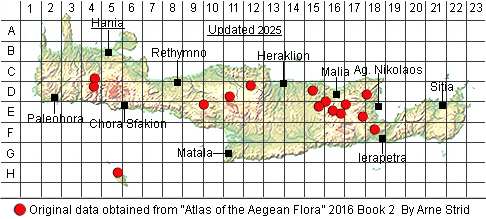
Distribution:- Common throughout mainland Greece. - Most of Europe and through
Anatolia to Caucasus and C Asia. Somewhat limited distribution on Crete mainly
around the three main massifs
Flowering time:- May to early June.
Photos by:- Steve Lenton