SPECIES DESCRIPTION
POLYGONUM MARITIMUM
Family and Genus:- See- POLYGONACEAE/Sect. POLYGONUM
Common Names:- Sea knotgrass
Homotypic Synonyms:- None
Meaning:- Polygonum (Gr) Many joints, a name used by the Greek physician and
botanist Dioscorides, a possible reference to the many nodes.
Maritimum (L) Growing by the sea.
General description:- Low, prostrate or sprawling perennial with a woody stock.
Stems:-
1) 10-50 cm, procumbent, branched, stout.
Leaves:-
1) 5-25 mm, narrowly elliptical, acute, glaucous, often blackening on drying,
margins revolute.
2) Ochreae, reddish-brown at the base, with 8-12 conspicuous, branched veins,
silvery-hyaline distally, longer than most of the internodes.
Flowers:-
1) Pink or whitish, solitary or in axillary clusters of 2-4; making up a leafy spike.
2) Bracts, leaf-like.
Fruit:-
1) Nut, 3·5-5 mm, equalling or slightly exceeding the perianth, glossy.
Key features:-
1) Stock, sparingly branched.
2) Stems, usually more than 10 cm.
3) Ochreae, with 8-12 strong, branched veins.
4) Nut, 3·5-5 mm.
Habitat:- A typical constituent of sandy beaches, together with Eryngium
maritimum, Medicago marina etc., rarely in ruderal habitats a short distance inland.
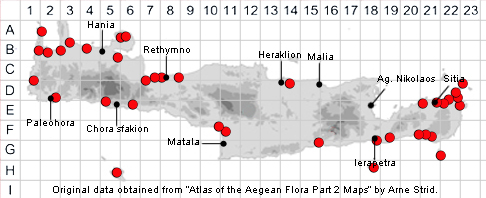
Distribution:- Fairly widespread around the Mediterranean coastal areas. Limited
distribution on Crete mainly in the west and east.
Flowering time:- Apr-July.
Photos by:- Fotis Samaritaki