SPECIES DESCRIPTION
OPHRYS CRETENSIS
Family:- ORCHIDACEAE
Common Names:- Cretan ophrys
Synonyms:- Ophrys sphegodes ssp. cretensis
Meaning:- Ophrys (L) Eye-brow, a name used by the Roman naturalist and
philosopher Pliny.
Cretensis (L) From Crete, Cretan.
General description:- Multi-flowered short to medium perennial, rarely more than
45cm. tall.
Leaves:- Basal leaves oval to lance-shaped, blunt, the stem leaves narrower and
pointed, sheathing.
Flowers:- The inflorescence is sparse with 2-10 small flowers. The sepals are
elongated, green in colour and 9-10 mm. in size. the petals are triangular, green or
greenish-yellow in colour and measure 6-7 mm. The lip is in one piece, its shape
varying from rounded to triangular, and measuring 8-10 mm. Its colour varies from
dark brown to dark reddish-brown with two out-growths on its base which are,
however, very small, sometimes almost non-existant. The blazon is shaped like an
"H", colour varying from Iight-blue to silver grey and bordered in white. The rest of
the lip is small and green. The general appearance of the flower resembles a
spider. The stigmatic cavity is rounded, dark reddish-brown in colour with a dividing
band in a lighter colour. The pseudo-eyes are shiny black.
Fruit:-
Key features:-
Habitat:- Scrubland vegetation, mixed scrub, in open woodland, meadows. 0-800
(-1100) m.
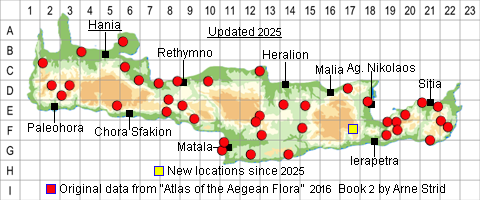
Distribution:- Endemic Crete & Kyklades. Fairy widely scattered across Crete,
but not too common.
Flowering time:- Mar to early June, peaking Apr-May.
Photos by:- Steve Lenton
FAMILY AND GENUS DESCRIPTIONS
ORCHIDACEAE
General description:- Perennial herbs with rhizomes, vertical stock or tuberous
roots, terrestrial, sometimes obtaining nutrition from decaying matter (saprophytic),
usually with symbiotic fungi in or on the roots (mycorrhiza).
Stems:- Sometimes swollen at base to form pseudobulbs.
Leaves:- Entire, spirally arranged or in two opposite rows, one on each side of
the stem (distichous), rarely subopposite, reduced to scales or sheaths in
saprophytes.
Flowers:- Inflorescence a spike or raceme. Flowers zygomorphic, the sepals,
petals and stamens apparently inserted higher than the ovary (epigynous), usually
hermaphrodite. Perianth-segments 6, in 2 whorls; median inner segment (labellum)
usually larger and of different shape from the others, usually directed downwards
owing to the ovary or the stem (pedicel) twisting through 180°, often with basal
spur. Anthers and stigma borne on a column formed from fused filaments and
style; stamens 1, rarely 2, with stalkless (sessile) or short-stalked (subsessile), 2-
celled (2-locular) anthers behind or at the summit of the column; pollen-grains
single or in tetrads, bound by elastic threads in packets (pollinia) which may be
narrowed into a sterile, stalk-like caudicle. Ovary inferior, 1-locular, with parietal
placentation, rarely 3-locular; stigmas 3, all fertile, or with the median sterile and
often consisting of a beak-like process (rostellum) between the anthers and fertile
stigmas; rostellum often forming 1 or 2 viscid bodies (viscidia) to which the pollinia
are attached; viscidia sometimes enclosed in 1(2), simple or 2-lobed,
membranous, pocket-like outgrowths (bursicles) of the rostellum.
Fruit:- A capsule, splitting open to release the seeds (dehiscing) by 3 or 6
longitudinal slits; seeds numerous, minute, with undifferentiated embryo and no
endosperm.
OPHRYS
General description:- Tubers 2(-3), globose or ovoid, entire.
Leaves:- Usually in a basal rosette, sometimes also present on stem.
Flowers:- Perianth-segments more or less spreading (patent), unequal; outer
oblong or ovate, obtuse; inner lateral smaller, often hairy.The lowest petal
(labellum) entire to 3-lobed, often convex and pouch-like (gibbous), sometimes
with an apical appendage which is often deflexed, hairless (glabrous) or velvety
(velutinous), variably marked, with usually glabrous central area (speculum); spur
absent. Rostellum minute. Viscidia in 2 simple bursicles.
Key features:-
1) Labellum neither inflated nor slipper-shaped; with distinctively coloured and
shaped central area (speculum).
Many species of Ophrys can cross to produce hybrids, which are often fertile.