SPECIES DESCRIPTION
MANDRAGORA OFFICINARUM
Family and Genus:- See- SOLANACEAE
Common Names:- Mandrake, Spring mandrake.
Homotypic Synonyms:- Mandragora autumnalis
Meaning:- Mandragora (Gr) Man-dragon, derived from the Syrian, namta ira, for
mandrake.
Officinarum (L) Official medicine, of the apothacaries.
General description:- Low, stemless, hairless or slightly hairy perennial with a
thick fleshy, often branched rootstock.
Leaves:-
1) In a rosette, usually spreading and flat on the ground, 12-20 cm long, ovate-
elliptic with an indistinct petiole, entire or irregularly sinuate-lobed, bullate,
subglabrous.
Flower:-
1) 30-40 mm, borne in the centre of the leaf-rosette, violet or purple.
2) Peduncles, slender, 2-8 cm. usually shorter than the leaves, appearing directly
from leaf rosette.
3) Calyx, slightly accrescent, with long, lanceolate-acuminate lobes, with
multicellular hairs and stipitate glands.
4) Corolla, broadly campanulate, 2-3 cm. in diam, with 5 triangular lobes and a
short tube.
Fruit:-
1) Berry, 25-30 mm long. broadly ellipsoid to obovoid, yellow or orange
Key features:-
1) Corolla, not more than 2·5 cm, greenish-white, with narrowly triangular lobes.
2) Berry, globose.
Habitat:- Rocky flats and slopes with dry open shrubby vegetation, open grassy
habitats, fallow terraces, wasteground, archaeological sites. 0-700(-1200) m. also
on small islands.
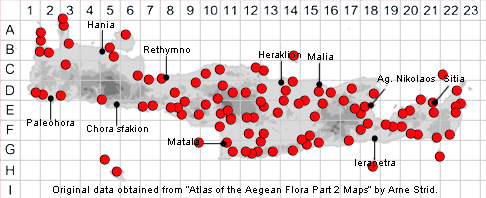
Distribution:- Widespread and common throughout the Mediterranean region.
Widespread and common on Crete.
Flowering time:- (Nov-)Jan to early Apr.
Photos by:- Steve Lenton