SPECIES DESCRIPTION
LIMONIUM SINUATUM subsp. SINUATUM
Family and Genus:- See- PLUMBAGINACEAE/Subgen. PTEROCLADOS
Common Names:- Winged sea-lavender
Homotypic Synonyms:- Statice sinuata
Meaning:- Limonium (Gr) Meadow-plant. A name used by the Greek physician
and botanist Dioscorides.
Sinuatum (L) With a wavy margin, winding, waved.
General description:- Glabrous perennial, forming a sub-shrub 10-45 cm tall, with
several erect to procumbent stems and a robust tap-root
Caudices:-
1) 0.5-3 cm long, branched, living leaves in rosettes at apices
Stems:-
1) With 4 undulate wings, 10-40 cm long, nearly straight, smooth, branching begins
above the lower two third of the stems.
2) Branches:
a) sterile, absent.
b) fertile, 3-10 cm long, straight to slightly curved, directed obliquely upwards,
forming branching angles of 35°- 45°, only longer branches divided in the
upper half; second branches broadly winged, apical with 3 short, lanate
appendices.
Leaves:-
1) Fleshy, dark green to grey-green, normally flat, 20-150 x 8-30 mm, oblanceolate
to pinnately lobed, apex round, with a bristle, 1-4 mm long, with one central
nerve and several pinnate lateral nerves, lanate at nerves and leaf margin,
gradually tapering into the petiole.
Flowers:-
1) Inflorescence, triangular to obovate in outline.
2) Spikes, short and dense, 6-13 mm long, straight.
a) spikelets fan-shaped, 12-15 mm long, composed of 2-3 flowers, very densely
arranged with 7-11 per cm.
3) Bracts:
a) outer, 4.3-5.8 x 3.3-4.8 mm, triangular to small triangular-ovate, acute, with an
awn, 1.0-2.5 mm long; bract in the upper half shaggily hairy; margin narrowly
membranous.
b) middle, membranous, 4.1-6.3 x mm, narrowly triangular, with 2 acute tips,
every tip with one awn, 1.5-2.5 mm long.
c) inner, 7.3-9.0 x 4.3-6.6 mm, oblong-trapezoid to elliptical, 2-lobed, margin
more or less broadly membranous; central part fleshy, green, oblong, on the
upper end with 2 fleshy, clawed, shaggily hairy appendices.
4) Calyx, very narrow, 11.5-14.5 mm long.
a) tube, shortly hairy;
b) lobes, very small, semi-circular to triangular; seam very plicate, blue.
5) Corolla, white to yellowish.
Fruit:-
1) With distal circumscissile dehiscence,
Key features:-
1) Stem with wings up to 3 mm wide.
2) Calyx-limb, entire or crenate.
3) Inner bracts, 4 with 2-3 almost spiny sharp terminal points (mucros).
Habitat:- Usually in maritime sand, occasionally along roads and in gravelly ruderal
habitats up to 450 m.
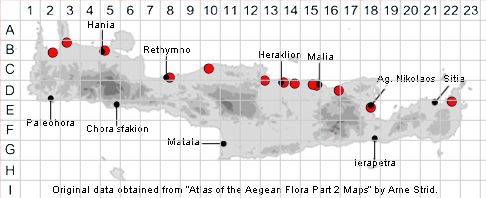
Distribution:- Widespread in the Mediterranean region. On Crete confined to the N
coast.
Flowering time:- (Mar-)Apr-June, occasionally later.
Photos by:- Steve Lenton