CYNARA CYRENAICA
Family and Genus:- See- COMPOSITAE/Sect. CYNARA
Common Names:- None
Homotypic Synonyms:- None
Meaning:- Cynara (Gr) Dog.
Cyrenaica (L) From Cyrenaica, Libya.
General description:- Perennial herb with enlarged, palisade-like root.
Stems:-
1) Upright with a few branches, height up to 80 cm, width 6-10 mm, with 14 to 20
striations, floccose-tomentose.
Leaves:-
1) Basal, forming a level large rosette.
2) Petiole, short or absent.
3) Lamina, with an outline broadly elliptical, deeply double lobed, dimensions 30-40
x 20-30 cm, rachis width 4-9 mm, with short and dense white woolly hairs,
a) main lobes, with narrowly lanceolate outline,
b) secondary lobes extended horizontally and in an alternating way from the
rachis, not straight and forming an angle of about 45o with it, linear-lanceolate
and green on the upper surface, with short and dense white woolly hairs,
slightly glandular on the lower surface, margin twisted, termination pointed,
brown-yellow spine.
4) Cauline, similar to the basal leaves, but shorter and with a lanceolate outline,
double lobed on the lower half, simply lobed on the upper half, 10-30 x 5-10 cm,
5) Upper cauline, almost subsessile, narrowly lanceolate in outline, simply lobed
along their whole length.
Flowers:-
1) Solitary heads at the end of the stems.
2) Bracts, 60-70, in 5-7 rows, leathery,
a) outer, blue-green, moderately to intensely violet, triangular to ovate, 6-8 x c.
3mm, moderately hairy, sharp tip ending in spine, middle bracts blue-green,
frequently with strong violet tones, sometimes with deep purple spots, broadly
longitudinal, 10-13 x 8-11 mm, slightly hairy to hairless, tip tapered abruptly to
a part narrowly linear, straight, level, length 3-4 cm, ending in a sharp, brown-
yellow spine.
b) inner, with shades of brown or red, almost linear, c. 3 cm x 3-3.5 mm, with
sharp tip.
3) Recepticle scales, 2-3 cm.
4) Ray florets, 70-80,
5) Corolla, 3-4 cm x 1-1.5 mm, edge purple or violet, 1-1.3 cm.
6) Anthers, almost white, length 6,5-7,5 mm.
7) Styles, purple, c. 4 cm, with lobes of length 6.5-8 mm.
8) Calyx, straw-coloured, wing-shaped, consisting of 100-150 hard level hairs 2-3
cm x 0.15-0.25 mm, in 3-5 rows.
Fruit:-
1) Mature achenes, oval, inflated, length 4-5 mm, black and white.
Habitat:- Slightly to very disturbed ground in limestone substratum. Also in open
sunny places at the edges of olive groves or cultivated fields, in terraces, at the
bottom of ditches and dry stone walls, as well as limestone rocks, sparse bushes
and low growth chiefly of annual herbs. 200-700 m.
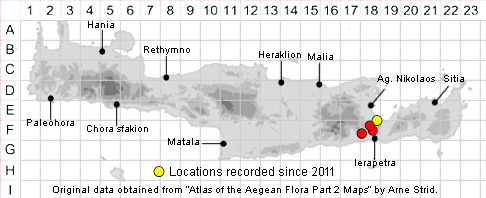
Distribution:- Endemic Crete & NE. Libya. Limited distribution on Crete, known
from a very small area between Aghios Nikolaos and Ierapetra in E. Crete. Very
rare6
Flowering time:- May-June
Photos by:- Steve Lenton
Protection status:-
Listed in "The Red Data Book of Rare and Threatened Plants of Greece" as "VU"
vulerable.
SPECIES DESCRIPTION