SPECIES DESCRIPTION
CUSCUTA EPITHYMUM subsp. EPITHYMUM
Family and Genus:- See- CONVOLVULACEAE
Common Names:- None
Homotypic Synonyms:- None
Meaning:- Cuscuta (L) A name used by the botanist Rufinus for dodder, from
Arabic keckout.
Epithymum (Gr) Upon thyme. (parasitic).
General description:- Scrambling and entwining parasitic plant.
Stems:-
1) Slender, filiform, much-branched, often reddish or purplish.
Leaves:-
1) Reduced to tiny scales, without chlorophyll.
Flowers:-
1) 3-4(-5) mm (rarely 2·5 mm);, 5-merous, mostly sessile, sometimes shortly
pedicellate; glomerules 7-10 mm in diam, dense, globose, each with a
subacute bract at its base.
2) Calyx, shorter than the corolla-tube, not fleshy.
a) lobes triangular, acute, sometimes lanceolate and acuminate.
3) Corolla-lobes, acute or acuminate to subulate, mostly shorter than the
campanulate tube.
4) Stamens, exserted; anthers often purple-tinged.
5) Scales, spathulate, shorter than the tube, fimbriate, connivent over the ovary.
6) Styles (including stigmas) much longer than ovary.
Fruit:-
1) Capsule, enveloped by the corolla.
2) Seeds, c. 1 mm.
Key features:-
1) Lobes of the calyx, and corolla, acute to acuminate.
2) Flowers, sessile or shortly pedicellate.
3) Styles, (including stigmas) much longer than the ovary.
4) Calyx, fleshy, reddish.
Habitat:- Parasitic on a wide variety of dwarf shrubs and herbs. 0-1800(-2400) m.
Distribution:- Fairly widespread and common across the Mediterranean.
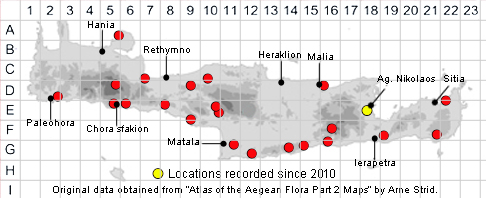
sporadically scattered across Crete.
Flowering time:- (Apr-)May-Aug.
Photos by:- Steve Lenton