SPECIES DESCRIPTION
CICHORIUM PUMILUM
Family and Genus:- See- COMPOSITAE
Common Names:- Dwarf chicory
Homotypic Synonyms:- Cichorium endivia ssp. divaricatum
Meaning:- Cichorium (Gr) A name used by the Greek philosopher Theophrastrus
from the Arabic 'kesher' for chicory.
Pumilum (L) Dwarf.
General description:- Hairless, or somewhat stiffly-hairy, medium to tall annual or
biennial; stems branched, erect.
Stems:-
1) 5-50 cm.
Leaves:-
1) Basal, arranged in two rows along a common axis but not separated into distinct
leaflets, pinnately-lobed to deeply toothed.
a) lobes, pointing towards the base, runcinate-dentate, short-petiolate, hairy.
2) Upper, lanceolate, toothed or not, amplexicaul, very hairy on the main veins.
Flowers:-
1) 25-40 mm, borne in leafy branched spikes, the axillary stemless, the others
terminal, short petiolate, with only the ray-florets toothed at the top, pale bright
blue, seldom pink or white.
2) Peduncles, of the terminal capitula strongly thickened.
3) Involucre, with 2 rows of bracts, the 8 external ones fused, the
a) outer flower-bracts, only a half the length of the inner.
Fruit:-
1) Achenes, none feathery, surmounted by a crown of scales.
2) Pappus-scales, 1/6-1/2 as long as the achene.
Key features:-
1) Peduncles, of the terminal capitula strongly thickened.
2) Pappus-scales, 1/6-1/2 as long as achene.
Habitat:- Cultivated and fallow fields, roadsides, occasionally in open dry shrubby
vegetation on eroded hill-sides, usually near the coast. 0-1100 m.
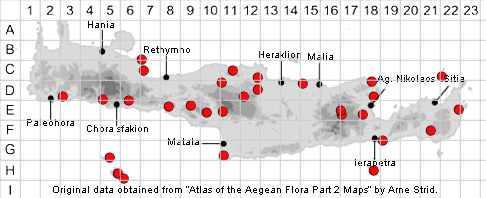
Distribution:- Scattered across the Mediterranean and through Anatolia to W & S
Iran. Scattered across Crete, not overly common.
Flowering time:- Mid-Apr to mid-July.
Photos by:- Fotis Samaritakis