SPECIES DESCRIPTION
CERINTHE MAJOR
Family and Genus:- See- BORAGINACEAE
Common Name:- Honeywort, Goldendrop
Accepted Infraspecifics:- Cerinthe major subsp. major, Cerinthe major subsp.
oranensis. Cerinthe major subsp. purpurascens.
Meaning:- Cerinthe (Gr) Wax-flower.
Major (L) Large, greater, bigger.
General description:- Rather fleshy, grey-green, almost hairless (glabrescent)
short to medium annual.
Stems:-
1) 15-60 cm.
Leaves:-
1) All covered with small, white, tuberculate.
a) Lower, oblong, broadest above the middle, petiolate, margin ciliate.
b) Upper, oval. amplexicaul, cordate, at the base.
Flowers:-
1) Bracts, ovate, subcordate, at the base, equalling or longer than the calyx, often
glaucous.
2) Calyx-lobes, acute, ciliate.
3) Corolla,15-30 x 5-8 mm, slightly saccate, straight, yellow, with a reddish-brown
ring in the throat, sometimes cream distally, or dark red throughout, more than
twice as long as the calyx.
a) lobes, ovate, sharply recurved at the apex.
Fruit:-
1) Nutlets, blackish.
Key features:-
1) Corolla, 5-8 mm wide, more than twice as long as the calyx. straight, yellow or
dark red, usually with red spots or ring at the throat.
Habitat:- Cultivated, fallow and waste places, roadsides, stony slopes, field
margins, seasonally damp roadsides. 0-400(-800) m.
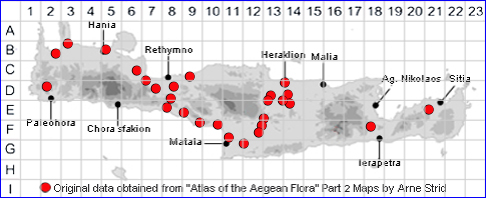
Distribution:- Widespread around the Mediterranean region eastwards to SW
Anatolia. but not the Balearic Is. or Cyprus. Somewhat limited distribution on Crete
mainly C and W.
Flowering time:- Mar-June.
Photos by:- Steve Lenton