SPECIES DESCRIPTION
CERASTIUM SCAPOSUM subsp. SCAPOSUM
Including
Family and Genus:- See- CARYOPHYLLACEAE
Common Names:- None
Homotypic Synonyms:- None
Meaning:- Cerastium (Gr) Horned, (the fruiting capsule's shape).
Scaposum (L) With scapes or leafless flowering stems.
General description:- Annual.
Stem:-
1) Up to 11 cm.
Leaves:-
1) 3-12 mm, ovate, obovate or elliptical, more or less obtuse, pubescent
Flowers:-
1) Usually solitary.
2) Pedicels, 30-70 mm. slender, pubescent-appressed
3) Sepals, 4-5·5 mm, ovate-lanceolate to lanceolate, more or less obtuse, with wide
scarious margins and apex, and long, appressed hairs not exceeding the apex.
4) Petals, longer than the sepals, bifid for c. 1/5 of their length.
5) Stamens 10.
6) Styles 5.
Fruit:-
1) Capsule, 6-8 mm.
2) Seeds, 0·6-1 mm, chestnut-brown, with small, minutely tuberculate.
Key features:-
1) Sepals, 4-5·5 mm.
Habitat:- Open calcareous woodland, soil patches in open shrubby vegetation,
rocky places, screes and gravelly mountain roadsides. (400-)1000-1700 m.
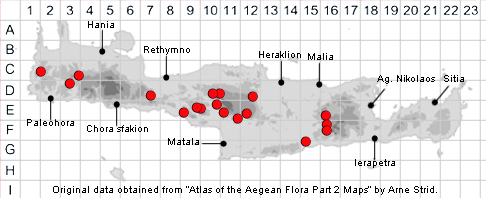
Distribution:- Endemic to the Lefka Ori, extending slightly eastward to Mount
Krioneritis, also one location south of Afendis Kavousi. Rare.
Flowering time:- Mar-June
Comment:- Plants from low altitude in NW Crete have been recognized as subsp.
peninsularum Greuter, N. Bohling & R. L. Jahn; they are in some respects
intermediate between subsp. scaposum and C. deschatresii. 1
1) Atlas of the Aegean Flora, Book 1 Arne Strid.
Photos by:- Fotis Samaritakis and Dr. Armin Jagel
~~~~~~~~~~~~~~~~~~~~~~~~~~~~~~~~~~~~~~~~~~~~~~~~~~~~
CERASTIUM DESCHATRESII Back to Top
Homotypic Synonyms:-
Meaning:- Deschatresii (L) Possibly for René Descartes a French philosopher.
Resembling C. scaposum, but differering in the following characters:-
1) Generally smaller in all parts.
2) Sepals, 2-2.5 mm.
3) Petals, rudimentary.
4) Stamens, 1-3.
5) Capsule cylindrical, with very short teeth (0.2-0.3 mm).
Habitat:- As for C. scaposum.
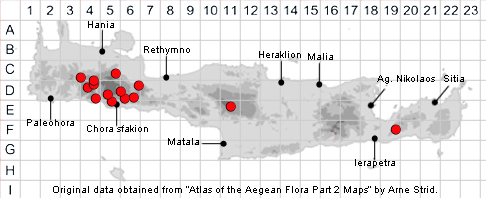
Distribution:- Endemic to the Lefka Ori, extending slightly westwards, also
Psiloritis and the Dikti mountains. Rare.
Flowering time:- As for C. scaposum.
Comment:-
C. deschatresii may be a selfing derivative of the large-flowered, C. scaposum.
obviously outbreeding it. In capsule characters it resembles C. comatum, which
may similarly be a selfng derivative of C. illyricum. 1
1) Atlas of the Aegean Flora, Book 1. Arne Strid 2016
Photos by:- None available