SILENE AMMOPHILIA subsp. AMMOPHILIA
Family and Genus:- See- CARYOPHYLLACEAE/Sect. CONOMORPHA
Common Names:- Sand catchfly, Striated catchfly.
Homotypic Synonyms:- Silene conica subsp. conica
Meaning:- Silene (Gr) A name used by the Greek philosopher Theophrastus for
catchfly.
Ammophila (Gr) Sand-loving.
General description:- Grey-pubescent annual.
Stems:-
1) Up to 15 cm, branched at base, procumbent or ascending, viscid above.
Leaves:-
1) Lower, up to 1·5 cm, (± withered at anthesis), spatulate, rather thick.
Flowers:-
1) In lax monochasia, occasionally with a single dichasial branching at the base;
pedicels straight.
2) Calyx, 5-9 mm 15-20 veined, cylindrical at anthesis, campanulate to obconical
and not narrowed above in fruit, truncate to slightly umbilicate at the base.
3) Anthophore, short.
4) Petal-limb, truncate to slightly retuse, pink.
Fruit:-
1) Capsule, 3-5 mm.
2) Seeds, c. o.8 mm, with keeled shoulders, radially striate.
Key features:-
1) Flowers, in lax monochasia, sometimes with one dichasial branching at the base
2) Calyx, 15-20 veined, 5-9 mm long.
3) Petals, pink.
Habitat:- Sandy and gravelly places, dry grassy meadows, deciduous scrub, field
margins. 0-1300 m.
Distribution:- Mainland Greece, Ionian Islands. Widespread in Europe and SW
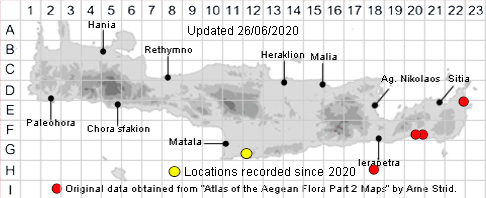
Asia. Rare on Crete currently known only from the Dikti mountains.
Flowering time:- Apr-June.
Photos by:- Marinos Gogolos
SPECIES DESCRIPTION