MINUARTIA HYBRIDA
Including Minuartia mesogitana
Family and Genus:- See- CARYOPHYLLACEAE
Common Names:- Fine-leaved sandwort
Homotypic Synonyms:- Alsine hybrida, Arenaria hybrida, Minuartia tenuifolia
subsp. hybrida
Meaning:- Minuartia (L) For Jaun Minuart (1693-1768), botanical writer of
Barcelona.
Hybrida (L) Mongrel, half-breed, hybrid.
General description:- Slender annual.
Stems:-
1) Erect, 3-12(-20) cm, branched at the base and from above the middle; plant
usually glandular-pubescent, at least above, or sometimes glabrous.
Leaves:-
1) Up to 12 mm. linear-lanceolate, 3-veined.
Flower:-
1) Cymes, lax, many-flowered.
2) Pedicels, 5-12 mm.
3) Sepals, (2·5-)3-5 mm, linear to ovate-lanceolate, acuminate; with narrow,
scarious, margins.
4) Petals, slightly shorter than the sepals.
Fruit:-
1) Capsule, 1-1½ times as long as sepals.
2) Seeds, (0·3-)0·4-0·6 mm, minutely tuberculate, reddish-brown.
Key features:-
1) Capsule, 1-1½ times as long as the sepals.
2) Seeds, (0·3-)0·4-0·6 mm.
3) Sepals, (2·5-)3-5 mm.
4) Petals, oblong, cuneate, at the base, usually less than half as long as the
sepals.
Habitat:- Dry open shrubby vegetation, scrubland vegetation, olive groves and open
woodland, on various substrates, 1100-1600 m.
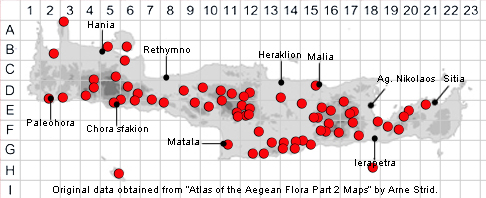
Distribution:- Fairly common throughout Greece. - A widespread and variable
species of Europe, the Mediterranean region and SW Asia to Afghanistan.
Widespread and fairly common on Crete.
Flowering time:- Late Mar to June.
Photos by:- Courtesy of Wiki-Commons
SPECIES DESCRIPTION
~~~~~~~~~~~~~~~~~~~~~~~~~~~~~~~~~~~~~~~~~~~~~~~~~~~~
MINUARTIA MESOGITANA Back to Top
Synonyms:- Sabulina mesogitana
Meaning:- Minuartia (L) For Jaun Minuart (1693-1768), botanical writer of
Barcelona.
Mesogitana Meaning unknown.
Resembling Minuartia hybrida , but differering in the following characters:-
1) Upper part of the stem an inflorescence patently glandular-pubescent.
2) Most pedicels more than twice as long as the calyx.
3) Sepals broadly lanceolate.
4) Petals 0.8-1.2 times as long as the sepals.
5) Capsule narrowly ovoid.
6) Seeds somewhat larger (0.45-0.6 mm)
Habitat:- Rocky slopes with dry open shrubby vegetation, scrubland vegetation or
open woodland, screes, road verges. 0-1300 m. (occasionally to 1800 m.), generally
on limestone
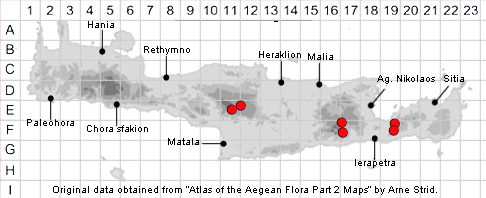
Distribution:- Mainland Greece and Peloponnisos but rare in the west. - Balkan
Peninsula, widespread in SW Asia. Rare on Crete known from only a few locations
in the C & E.
Flowering time:- Mid-Apr to June.
Photos by:- Trajche Dimitrovski