SPECIES DESCRIPTION
LIMONIUM ECHIOIDES
Family and Genus:- See- PLUMBAGINACEAE
Common Names:- None
Homotypic Synonyms:- Statice echioides, Taxanthema echioides.
Meaning:- Limonium (Gr) Meadow-plant. A name used by the Greek physician
and botanist Dioscorides.
Echioides (L) Resembling echium.
General description:- Glabrous annual, forming a sub-shrub 5-45 cm tall, with few
erect to ascending stems and a thin tap-root
Caudices:-
1) very short, 5-10 mm long.
Stems:-
1) 3-40 cm long, straight to slightly flexuous, rugose, branching begins normally
above the lower third.
2) Branches;
a) sterile, absent.
b) fertile, 4-50 mm long, straight to slightly flexuous, directed obliquely upwards,
forming branching angles of 40°- 60°, sometimes branched in the upper half.
Leaves:-
1) In a basal rosette, withered at anthesis, 7-55 x 3-16 mm, cuneate to spathulate,
apex obtuse to round, dark green or purple when semi-dry, normally flat,
surface with tuberculate glands, with one central nerve and pinnately branching
lateral nerves, gradually tapering into the very short petiole.
Flowers:-
1) Inflorescence, trullate or obovate in outline.
2) Spikes, very long, 2-18 cm, arched, directed obliquely upwards to spreading.
a) spikelets, 6.5-8.5 mm long, composed of 1-4 flowers, very remotely arranged
with 1-2 per cm, laterally slightly curved near the base, sometimes nearly
clustered.
3) Bracts:-
a) outer,1.8-2.3 x 1.4-1.8 mm, triangular-ovate, acute to obtuse; bract margin
narrowly membranous; central part fleshy, tuberculate, acuminate.
b) middle, membranous, 1.9-2.3 x 1.1-1.8 mm, oblong-obovate to oblong-elliptic,
rounded.
c) inner, 4.8-6.4 x 2.4-3.5 mm, oblong to narrowly obovate, rounded to obtuse,
margin very narrowly membranous; central part thick-fleshy, tuberculate with
glands, 4.2-5.5 x1.8-3.2 mm , oblong-obovate, acuminate, forming a
triangular tip, 0.5-1.0 mm long, reaching the upper margin.
4) Calyx, narrow, 5.3-6.1 mm long, exceeding the inner bract by 1.5-2.0 mm;
a) tube, glabrous or with some short hairs in the middle part, with 5 ribs ending
near the upper margin;
b) lobes, ca. 1.0 × 0.3 mm, narrowly triangular, shortly dentate between the
lobes; calyx margin, lacerate after anthesis.
5) Corolla, pale lilac.
Habitat:- Sandy and rocky maritime habitats, occasionally along roads and in dry
open shrubby vegetation some distance inland up to 300 m.
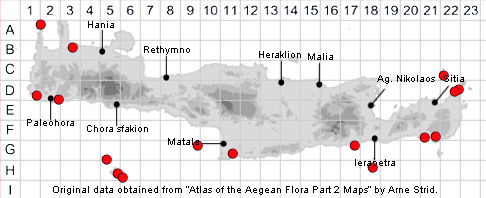
Distribution:- In Greece almost restricted to the Aegean area. - Widespread in the
Mediterranean region from S France to Cyprus. Sparsely scattered on Crete.
Flowering time:- April-June.
Photos by:- Christopher Cheiladakis